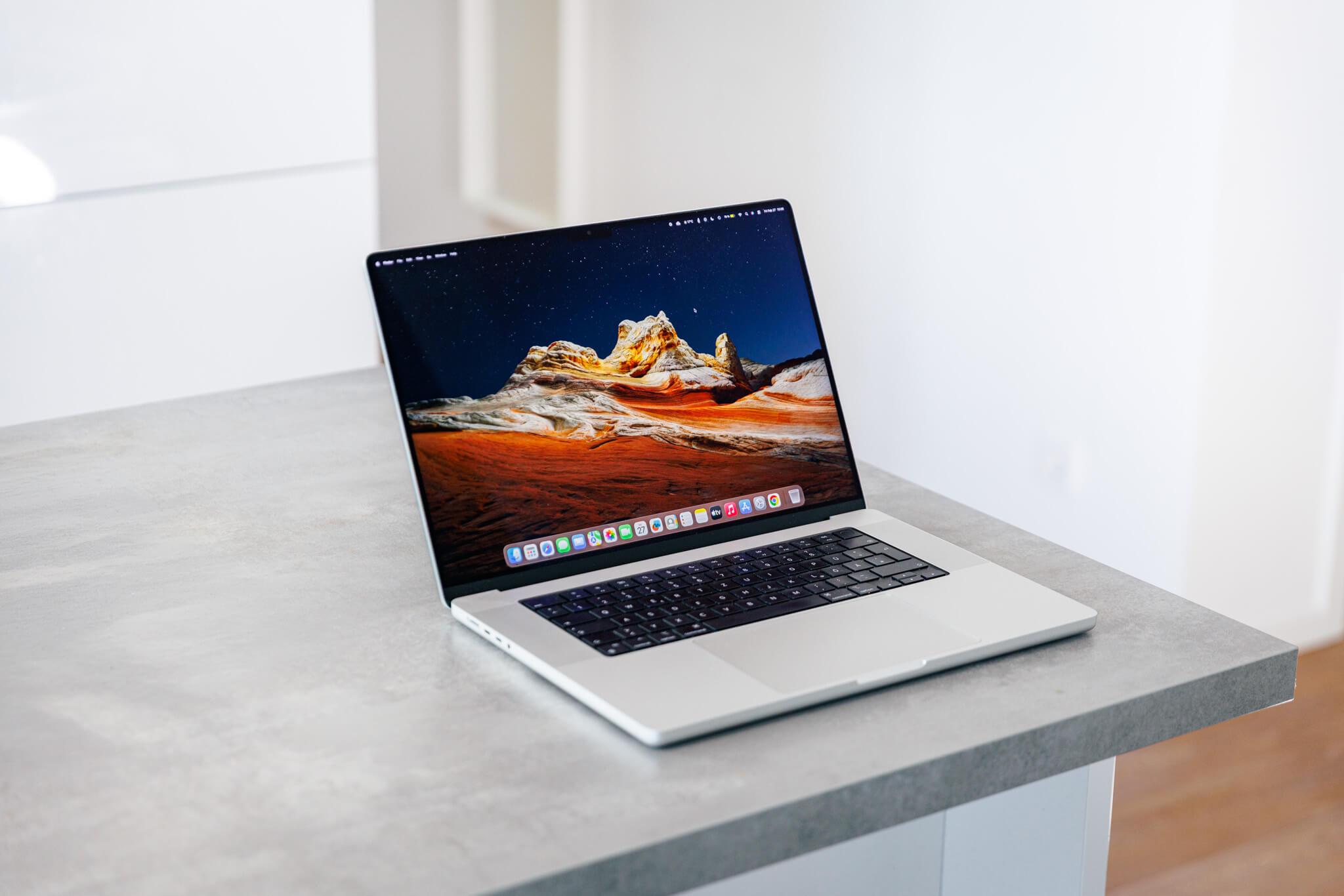
I picked up an M1 Max MacBook Pro 16″ in June 2025 for €1,400 used. 32-core GPU, 64GB RAM, 2TB SSD.
Coming from an M1 Pro with 16-core GPU and 32GB, it wasn’t a desperate upgrade. But that price was hard to ignore.
Several months in, I can tell you the M1 Max MacBook Pro is still genuinely excellent in 2026. But it’s not for everyone, and the reasons you should or shouldn’t buy one are probably not the ones you’re expecting.
What You’re Actually Getting for the Money
At €1,400 used, you’re not buying a budget machine. You’re buying something that, when it launched in late 2021, cost well over €3,500 configured.
Four years later, the hardware still reads like a premium spec sheet. The Liquid Retina XDR display. MagSafe. An SD card reader. Thunderbolt 4. A keyboard that’s held up across years of daily use. Build quality that genuinely still looks and feels new.
The M1 Max chip itself has 32 GPU cores and up to 400GB/s of memory bandwidth. That was extraordinary in 2021. In 2026, it’s still faster than most laptops you can buy at anywhere near this price point.
The honest comparison for used pricing right now is, the new M4 MacBook Air which starts at around €1,300. Same ballpark. Very different machine.
The Screen Is Still the Whole Argument
If you work with photos or video, this is the section that matters most.
The 16″ Liquid Retina XDR panel runs at up to 1,000 nits sustained and 1,600 nits peak. It covers wide colour (P3), it has ProMotion at 120Hz, and it renders HDR content the way it’s supposed to look.
The M4 MacBook Air doesn’t have this display. It’s a good screen. But it doesn’t have the brightness, the HDR range, or the miniLED backlight that the MacBook Pro has had since 2021.
For anyone colour grading, editing RAW stills, or reviewing HDR footage, the Pro display is a meaningful difference. At current used prices, you’re getting a professional-grade panel for less than a new Air.
The only display upgrade coming is the OLED MacBook Pro with M6 chips, rumoured for late 2026 at the earliest. That machine is going to be expensive. If you need a great display right now without paying flagship prices, the M1 Max Pro is still a serious answer.
How It Holds Up for Real Creative Work
I edit 45MP Canon RAW files in Lightroom daily. The M1 Max handles it without complaint. Previews are fast, batch edits apply quickly, and exporting a full catalogue doesn’t make the fans spin up like a jet engine.
For 4K RAW video workflows, it’s more than capable. The chip has two video encoders and two ProRes decode engines, which is actually the same count as the M4 Pro Mac mini, for context. A 4K 14-minute timeline with effects and B-roll exports in around four minutes on mine.
8K RAW is where things get more nuanced. You can work with it. But real-time playback with heavy effects and colour grading? That requires proxy workflows. It’s not a dealbreaker, most serious editors use proxies anyway, but it’s worth knowing before you buy.
For semi-professional photo and video work, content creation, design, and development, the M1 Max is more than enough in 2026. If you’re a broadcast colourist or a studio doing multi-stream 8K dailies, you’ve already moved on to M4 Max or Studio hardware. But that’s not who this laptop is for at this price.
The Honest Trade-offs
The 16″ MacBook Pro is heavy. It weighs 2.15kg. If you carry it in a bag every day, you notice.
I use mine mostly docked to a monitor. That context makes the weight irrelevant. But if you’re someone who works from cafés, on planes, or moves between desks constantly, that’s a real consideration. My next laptop will probably be a 14″.
Battery life is good but not exceptional. My unit reads 86% health after a few years of use, and in daily work I get a solid day, but nothing like the M4 Air, which runs for what feels like two full workdays on a charge. Again, mostly docked, so it matters less. But if you’re hoping for fanless-Air-level portability, this isn’t that.
Software support is another honest thing to flag. M1 launched in late 2020, and Apple historically supports Macs for around seven years. You’re likely looking at macOS support through 2027, possibly one cycle beyond that. It’s not a machine you’ll run for a decade, but three to four more years of full support is completely reasonable at this price.
One more thing: go 16″ over 14″ if you want the M1 Max. The 14-inch version used the same cooler as the M1 Pro, which led to thermal throttling under sustained load. The 16-inch has a proper cooling system. It’s the version that earns the chip.
Should You Buy an M1 Max MacBook Pro in 2026?
Yes, if:
- You do photo or video work and want a professional display without paying for a new M4 Pro
- You’ve found a well-maintained used unit for €1,200–€1,500
- You work primarily docked or don’t mind the weight
- You’re coming from an Intel Mac or an older M1/M1 Pro and need a meaningful performance step
Probably not, if:
- You want maximum battery life and maximum portability, the M4 Air does that better
- You need real-time 8K playback with no compromises
- You’re planning to run this machine for more than five or six years
- You’re willing to spend €2,500+ in which case an M4 Pro or M4 Max gives you more headroom
One useful calibration point: I can’t meaningfully tell the difference between working on my M1 Max MacBook Pro and working on a current M4 Mac in day-to-day use. That’s how good Apple Silicon was, even at generation one.
The M1 Max MacBook Pro is not a compromise buy. It’s a genuinely good machine at a price that now makes a lot of sense. The screen, the build quality, the memory bandwidth, the ProRes hardware, that combination hasn’t aged out. It’s just gotten cheaper.
The Bottom Line
If you work with photos or video and you’re looking at the used market, the M1 Max MacBook Pro 16″ is still one of the best laptops you can buy for creative work in 2026.
Not because it’s the fastest. It isn’t. But because the things that make it excellent, the display, the unified memory, the ProRes engines, the build quality are all still excellent. And at €1,200 – €1,500 used, they’re now accessible.
The M4 Air is a better machine for someone who wants lightness and battery above all else. The M1 Pro is fine for everyday tasks. But for the semi-professional creator who wants a professional display and real GPU headroom without a €3,000+ outlay, the M1 Max is still the answer.
It was a great machine in 2021. It’s a great deal in 2026.