At some point on a shoot, I looked in my backpack and realised I hadn’t touched about 60% of what I’d packed.
Not because I didn’t need it. Just because I’d packed for every possible scenario and then shot the way I always shoot: one camera, two lenses, done.
That’s when the minimalist camera kit thing clicked for me. Not as a philosophy. Just as a practical observation.
The real cost of too many options
Gear acquisition syndrome is a well-documented affliction and I had it bad. At one point I’d owned almost every Canon body in a series. Not all at once, but over time, testing, comparing, chasing the next thing.
The problem isn’t the buying. It’s what happens on a shoot when you have too many options. You start thinking about gear instead of shooting. You’re in your head about which lens to use instead of actually looking at the frame.
Having less forces a kind of clarity. When you know you’ve only got the 24-105mm on you, you stop second-guessing and start composing.
That trade-off is real. You’ll occasionally wish you had something else. I just got back from a week in Madrid and I genuinely missed the 15-35mm. Found myself in situations where 24mm wasn’t wide enough and I’d made the call to leave it at home to save weight. That one stung a little. But it was a personal project, nothing a client was paying for, and I got good shots anyway. More importantly, I wasn’t carrying half a studio around the city for a week.
The weight saving alone changes how you shoot. When your bag is lighter, you walk further, you stay out longer, you’re less precious about where you stop.
How I actually got over gear acquisition syndrome
Counterintuitively: by buying more gear first.
I went through a phase of buying used Canon bodies deliberately, just to try them. Every model I’d been curious about. The whole 1D series, basically. Not all at once, but steadily, over time. I wanted to know what I was missing, so I stopped wondering about it.
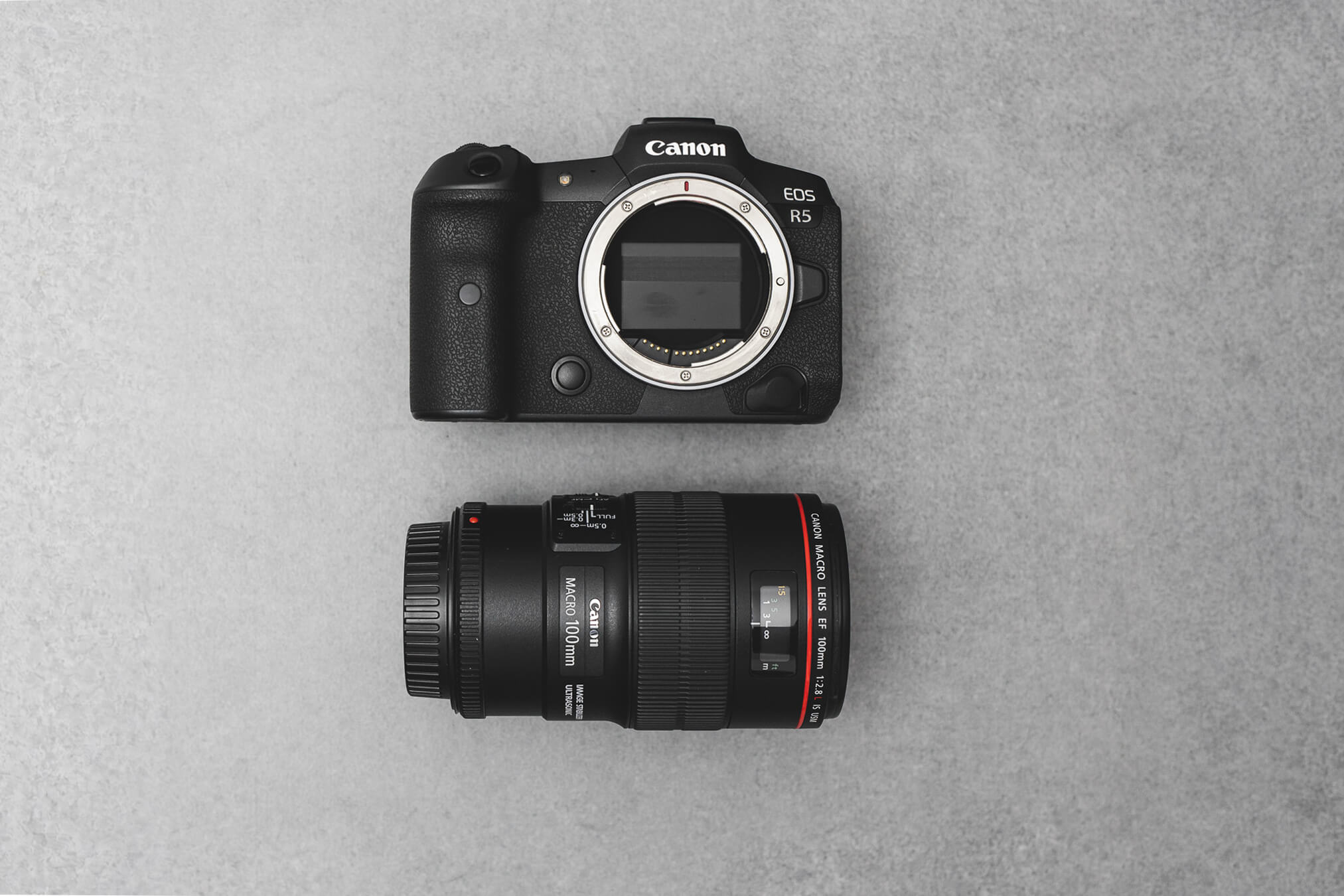
At some point I ran out of things to be curious about. I had tried everything I found interesting. And I landed on the R5 Mark II. That’s the camera no other camera in my current lineup competes with, for what I actually do.
The key word there is “used.” Buying used gear is how you do this without losing money. You try something, you learn something, you sell it on for close to what you paid. That’s the smart version of GAS. Not buying brand new every time something gets announced.
If you’re at the start of your gear journey, do the curious phase deliberately. Buy a used DSLR, try it, sell it, try something else. Get the curiosity out of your system properly. You’ll land somewhere faster.
What my kit looks like now
Current kit: R5 Mark II. RF 24-105mm F4. RF 15-35mm F2.8. RF 35mm F1.8. RF 28mm F2.8. RF 70-200mm F2.8. RF 100mm Macro.
That’s still not a small kit on paper. But I don’t bring everything every time. The kit is more like a menu. I pick what makes sense for the shoot.
And I made a deliberate call to step down from L-series glass on some of the primes. The 35mm F1.8 instead of the 50mm F1.2. Lighter, smaller, and it means I can fit an extra lens in the bag if I need it. On paper, the L-series is better. But if I’m leaving the 50mm at home because it’s too heavy to bother with, it’s not actually better for me.
The one lens I almost sold (and now use constantly)
The RF 24-105mm F4 came in a kit. I bought it not really wanting it. I had the 24-70mm F2.8 already, and I thought, what do I actually need an F4 zoom for?
A few days after I got it, I took it to Madrid on a trip. A friend pushed me to just try it. I did. And within a day I knew I was keeping it.
It’s been on my camera more than any other lens since. The reach is what gets you. 105mm covers a lot of situations where you’d otherwise be changing lenses. It’s image stabilised, which matters a lot for handheld video. F4 is more than fine in daylight, and with ND filters, it’s genuinely the most useful piece of glass I own.
I had the EF version for a while too, kept it for the EF mount on the RED. That’s gone now since I sold the DSMC2. I don’t miss having two of them.
The lens I barely touch (and why I’m keeping it anyway)
The 70-200mm F2.8. I use it maybe a handful of times a year. But I’m not selling it.
Telephoto reach is one of those things where you either have it or you don’t. When you need 200mm, nothing else gets you there. And the RF version is significantly smaller and lighter than the EF equivalent. That size difference is actually why I’d stay with Canon for a telephoto if I was comparing systems right now. The old EF 70-200 had to lie flat in a bag. The RF version stands upright, which saves a surprising amount of packing space.
So it stays. Some gear you keep not because you use it constantly, but because the cost of not having it on the rare occasions you need it is too high.
What I’d tell someone starting out
Don’t buy new. Seriously. A used Canon DSLR from five years ago still takes great photos. Buy one, learn it properly, figure out what actually frustrates you about it, then decide what to upgrade.
The gear that stays in your kit is the gear you know so well you stop thinking about it. That’s what you’re working towards. Not the best spec sheet. Not the newest body. The thing you reach for without thinking.
ND filters are the unglamorous answer to “what should I buy first for video.” I resisted buying them for years. I was wrong. Buy them early.
And if you find yourself deep in GAS, the fastest way out is through. Try the things you’re curious about, buy used so you can sell without losing money, and let the curiosity run its course. Eventually you’ll have tried enough that the next announcement doesn’t move you.
That’s roughly how I got here. One R5 Mark II, a small selection of lenses I actually understand, and a backpack that’s noticeably lighter than it used to be.
The bottom line
A minimalist camera kit isn’t about owning less for its own sake. It’s about owning exactly what you use, knowing it well enough that it disappears when you shoot, and not carrying the weight of everything you might need someday.
Buy used. Try things. Sell what you don’t use. Keep what you reach for without thinking.
If you want to read more about my decision to sell the RED DSMC2 and whether it makes sense in 2026, that post is here. And if you’re trying to figure out whether the Canon RF 70-200mm is worth keeping in a minimal kit, I wrote about that too.