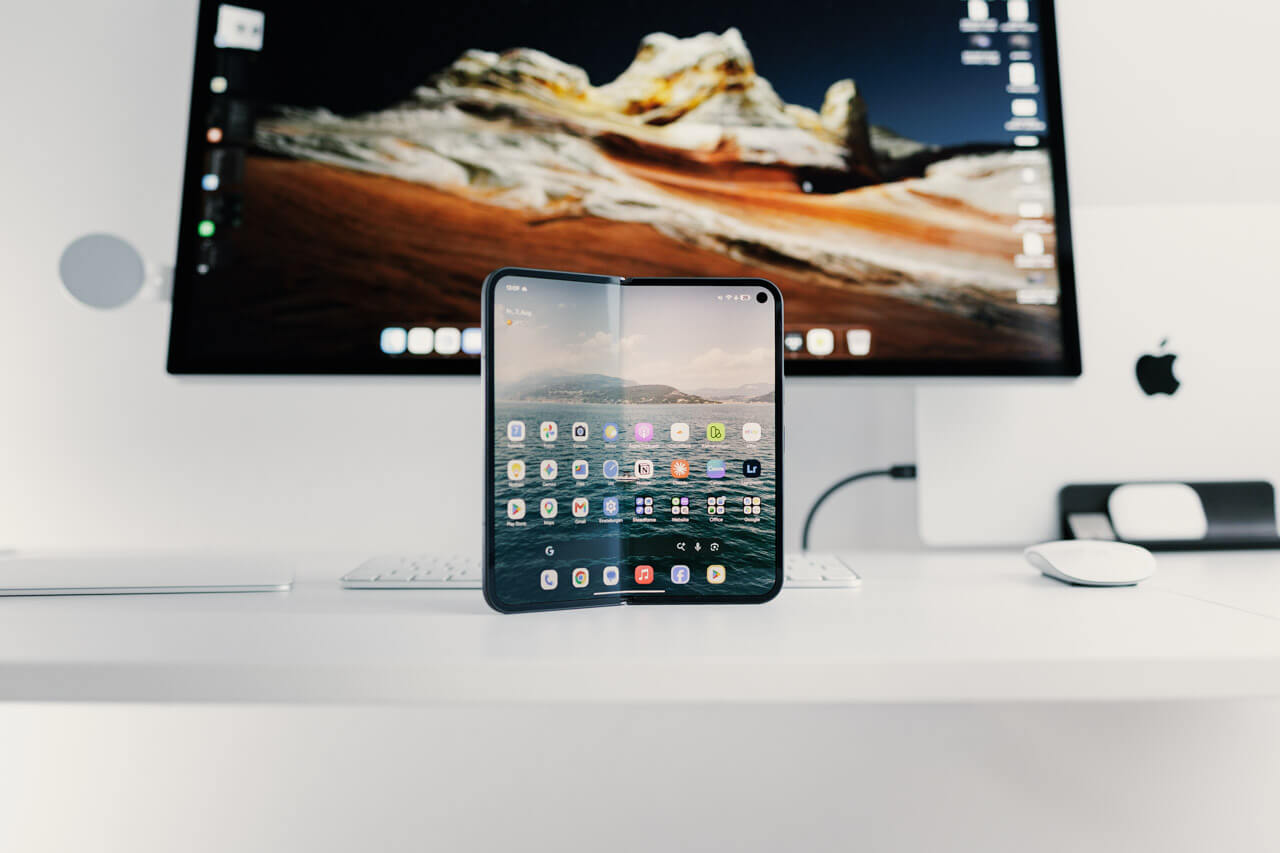
Every foldable phone pitch makes the same promise: bigger screen, more space, more done. I had one of Samsung’s own promo videos show up in my feed making that exact case a while back, and when I actually watched it, nothing in it looked like something I could not already do on a regular phone. I wanted to test that foldable phone productivity promise for myself instead of just taking an ad’s word for it.
I have been on an iPhone for eight years. I do not like working on a phone, and I am not much of a tablet person for my kind of work either. A small laptop has always felt like the right tool. So when this pitch kept showing up in my feed, I got curious enough to actually test it.
I bought a Pixel 9 Pro Fold and used it as my main phone for two weeks, mostly during a trip to Madrid where I worked from cafés, an airport, and a friend’s living room. My laptop stayed in the bag as the actual main device the whole time, but I pushed myself to do as much work as possible on the phone alone, specifically in the moments away from a desk. Here is what I found.
The pitch I wanted to believe
My day job is marketing. Campaign data, campaign graphics, coordinating with different teams, publishing and editing content, project management. A lot of different tools, a lot of switching between them. A bigger screen sounded genuinely useful for that, not just for watching a wider YouTube video.
But foldables have had six years to prove this. They still make up roughly 2.5 percent of global smartphone shipments, and market researchers keep pointing to the same reason: friction. People have to relearn how they hold a phone, how they multitask, how they type. That is a lot to ask for a device that starts north of 1,800 euros.
I saw someone ask on Reddit, half genuinely confused, why foldables still are not more popular six years in. The replies mostly landed on the same two things: the price, and the fact that a bigger screen alone never turned out to be the feature that changed anyone’s day.
There was also the money question. A foldable costs about double a normal flagship for double the screen, not double the phone. I did not want to spend that much just to end up back on a regular phone a month later. So the plan was simple: use it like I actually needed it for work, not like a toy.
Two weeks, phone first, laptop in the bag
I set it up with everything I actually use day to day: Jira, Outlook and the rest of Office, HubSpot, a couple of campaign management tools, Canva for quick graphics, and Lightroom for photo edits. Then I went to Madrid for about ten days and used the phone for as much of my actual work as I could, on purpose, before giving in and pulling the laptop out.
Folded shut, it was barely thicker than my old iPhone sitting in a case, so it never felt like carrying two devices. That part of the pitch was true from the first day and stayed true the whole trip.
Where foldable phone productivity really pays off
Some of it worked exactly as advertised. Reviewing spreadsheets was easier with more cells visible at once. Reading and answering email felt closer to doing it on a laptop than on a normal phone. If your day is mostly Outlook, Teams, and Excel, the extra space genuinely helps.
Video looked fine too, though not dramatically better. The Pixel Fold’s inner screen is close to square, so widescreen video does not gain nearly as much room as you would expect from an 8-inch panel.
Where it fell apart
Jira was the clearest example. Opening a ticket did not give me a proper multi-column layout the way it does on a desktop browser. It just stretched the phone layout across the full width, one column, everything stacked underneath everything else. More screen, same information, just bigger.
This turned out to not be a Jira problem. It is an Android-wide one. Google has spent years trying to get developers to stop shipping stretched, phone-only layouts on tablets and foldables, most recently with new resizability rules in Android 16 and 17. Apps built with fixed-width buttons and cards look fine on a phone and just stretch across the whole screen once you unfold it.
Lightroom had a version of the same problem. On the desktop, or on an iPad, you get your photo in the middle and your sliders on the side, a proper working layout. On the Pixel Fold, it was still the phone app underneath: tabs at the bottom, tap into a tool, then work through the sliders. Bigger, but not more capable.
Six years after the first foldable shipped, this still comes down to which specific apps a developer bothered to rebuild. Your experience will vary entirely based on your own toolset, which is not something a marketing video ever tells you.
Day one versus a month later
On day one, unfolding a phone into something the size of a small tablet feels like a genuine upgrade. You notice the extra space immediately, and it is fun.
It has been about a month since that trip now. The phone sat on my desk for a while after I got back, then moved into a drawer. I have not picked it up since. I do not miss it either.
I am back on my iPhone for the same work: same email, same spreadsheets, same Jira tickets. Nothing about it feels slower or more limited than it did with the fold in my bag. If the bigger screen had actually been doing something for me, I think I would have noticed its absence by now.
Who a foldable phone actually helps at work
If your job runs on email, Excel, Teams, and maybe Confluence, a foldable will make that faster and more comfortable. That is a real, honest use case.
If your job involves creating things, graphics, layouts, photo or video edits, anything that benefits from a proper desktop-style interface, a foldable will not get you there. I would have been faster doing the same tasks on a small laptop every single time.
Price is worth sitting with too. A foldable is not a small purchase, and foldables lose value faster than a normal flagship, more than 60 percent within six months versus roughly 50 percent for regular flagship phones. That is not a reason to avoid one, but it is a reason to be honest with yourself about whether you will actually use the fold, or just the phone.
What could change this
Samsung seems to have read the same complaints I had. The new Galaxy Z Fold8, which launched this week at 2,000 euros, ships with what Samsung calls Partner Business Apps: more than 5,000 apps optimized specifically for the Fold8 screen, including the full Microsoft 365 suite, Google Workspace, and Adobe Creative Cloud. That is Samsung trying to solve the exact stretched-Jira problem directly, instead of waiting for every developer to get around to it.
Apple’s rumored foldable iPhone is the other open question. It is expected sometime around September 2026, unconfirmed, likely priced north of 2,000 dollars, and there is nothing official from Apple yet. If Apple holds it to the same app-quality bar it holds the iPad to, from day one instead of six years in, that alone could change this whole conversation. If not, it will just be a very expensive way to find out the same thing I did.
The bottom line
A foldable phone does not make you more productive by itself. It only removes friction from the specific tasks your apps are actually built to handle on a bigger screen, and for most creative and project work, that list is still shorter than the marketing suggests.
The clearest proof of that is what happened after I stopped using it. A month later, the Pixel Fold is in a drawer, I am back on a normal iPhone doing the same work, and I genuinely do not feel the difference. Not slower, not more limited, nothing I am missing. If a device that expensive can disappear from your workflow that quietly, it was never the upgrade it was sold as.