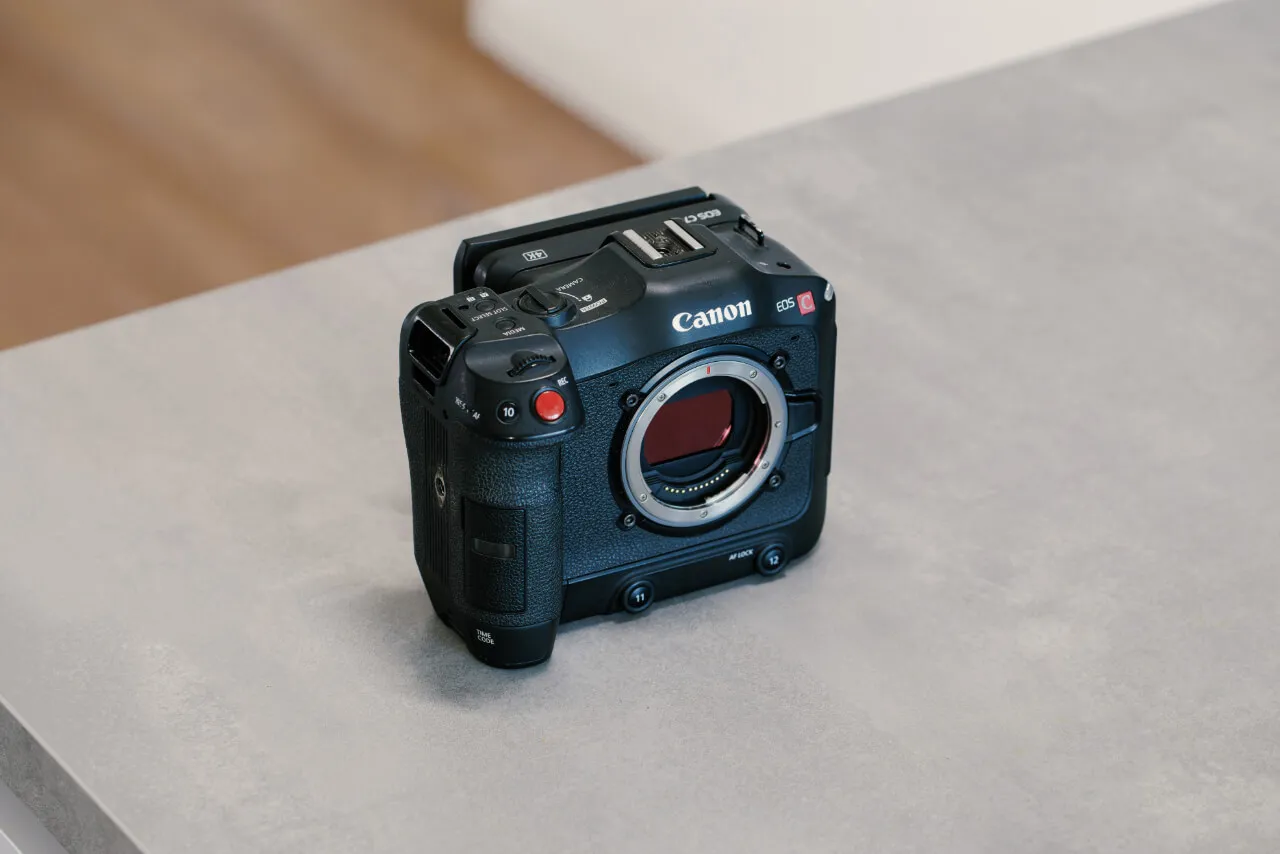
A few months ago I found a Canon C70 online for basically nothing.
The seller had priced it low because of a hinge fault that plagued the early production run of this camera. The screen loosens over time and stops sitting flush anymore. After I sold off the accessories I didn’t need, the camera itself came down to €400.
For a C70, that’s an insane price.
I almost flipped it straight away. I already own an R5C and an R5 Mark II, and three cameras is at least one too many for how I actually shoot. But after using it for a few weeks, I couldn’t let it go. Here’s my honest take on why, and whether the C70 still makes sense to buy in 2026.
How I ended up with a €400 Canon C70
Early C70 units share a known problem. The screen hinge wears loose and stops holding its position, so you end up manually propping the display wherever you want it to sit. It’s annoying. It’s not a dealbreaker.
Everything else on the camera works exactly like it should. Sensor, autofocus, internal ND filters, recording formats, all of it functions normally. The hinge is cosmetic, not structural.
That one flaw is the entire reason this camera showed up in my price range. If you come across a C70 listed cheap and the seller mentions a wobbly screen, that’s almost certainly why. It means you can get an excellent cinema camera for a fraction of its original cost, as long as you’re fine living with a slightly loose hinge.
The DGO sensor is the whole story
Canon’s Dual Gain Output sensor is the reason the C70 still holds up against cameras released years after it.
Straight out of camera, the color looks warmer and more filmic than anything I get from my R5C or R5 Mark II. There’s a subtle grain running through the image that gives it character instead of looking clinically clean. Some of that comes down to sensor size and the resulting depth of field. Most of it is just how Canon tuned this sensor.
It’s not the best choice for low light. There’s no dual base ISO or triple base ISO the way some competitors offer, so it’s not the camera I’d reach for in dark environments. But in daylight or controlled lighting, I’d put this sensor up against almost anything at this price point.
Dynamic range and highlight roll-off still impress me years later. The R5 Mark II, despite being the newer camera, doesn’t beat it here. Neither does the R5C. When people say the C70 was never really “beaten” on sensor character, even by Canon’s own newer bodies, that’s not nostalgia talking.
Autofocus changes everything compared to a Komodo or Blackmagic
This is where the C70 separates itself from the cameras people usually compare it to.
I looked hard at the RED Komodo before settling on the C70. Similar image character, similar price range depending on the deal, but no autofocus. You’re also looking at raw-only recording on most Blackmagic cameras in that class, plus the added cost of an external monitor and rigging just to make the Komodo usable day to day.
The C70 gives you that cinema sensor and still lets you autofocus normally. You can shoot compressed MP4 or XF-AVC instead of committing to raw for every single clip, and you can skip the external monitor entirely. That combination, cinema-grade image, real autofocus, and a form factor that doesn’t need extra rigging, is rare. It’s the main reason I’d point most people toward the C70 over a Komodo, unless raw is a non-negotiable for your workflow.
Battery life, SD cards, and not needing more gear
The BP-A30 battery sits flush in the body. No cage, no external battery plate, no cables running to a V-mount somewhere. You charge it, you shoot, and the battery lasts long enough that I rarely think about it mid-shoot.
It also takes standard SD cards. That sounds like a minor detail until you’ve dealt with the Komodo’s CFast Card requirement, which meant for me to buy another card reader and a set of cards that only work with that one camera. With the C70, a single 128GB SD card gets you somewhere around an hour of footage depending on codec, and you can swap cards mid-shoot without any special hardware.
None of this is exciting on paper. In practice, it’s the difference between grabbing the camera and shooting versus rigging up a small system every time you want to use it.
Which camera I’m actually keeping
Here’s the part I didn’t expect going into this. I own an R5C for cinema-style shooting already, and I recently sold an R50 V that I’d bought specifically for smaller, vertical-mountable content.
The C70 is heavier and bulkier than the R50 V ever was. It’s not the compact, grab-and-go camera for social content. But the image it produces made me like carrying the extra size. Running three cinema-style cameras at once doesn’t make sense for one person, so I’m now deciding whether to sell the R5C and keep the C70, or the other way around. I haven’t landed on an answer yet. Needing to make that call at all says a lot about how good the C70 turned out to be.
Where the C70 falls short
I want to be upfront about the downsides, because there are a few real ones.
The menu isn’t touch-enabled, even though the screen itself is a touchscreen everywhere else. On my R5C, I can tap through menus directly. On the C70, I have to use the joystick. It might be a firmware quirk specific to my unit, but it’s been consistent every time.
There’s no interval or time-lapse recording in raw. I wanted to shoot a time-lapse and the option simply isn’t there, despite the R5C offering interval recording up to 8K. I don’t know why Canon left this out of the C70’s firmware.
If you’re chasing open gate recording, the C70’s 17:9 sensor won’t give you the height advantage of a 3:2 sensor like the one in the R6 V. You can get closer by shooting 4K DCI, but it’s not the same result. Honestly, I think open gate is a bit overhyped for most people’s actual use cases. It’s nice to have. It’s not a reason to skip this camera.
Is the Canon C70 still worth buying in 2026?
Yes, if you know what you’re buying it for.
Prices on the C70 are competitive right now, often cheaper than a new R5 Mark II, R6 V, or C50. If you want a proper cinema camera with real autofocus, internal ND filters, and a sensor that still beats plenty of newer options in daylight, the C70 remains one of the best value cinema cameras Canon has ever made.
It’s not the right camera for low light, and it’s not the smallest option if size is your priority. But for controlled lighting, narrative work, or any project where image character matters more than spec sheets, I don’t think there’s a better combination available at this price right now.